
 4 weeks ago
34
4 weeks ago
34
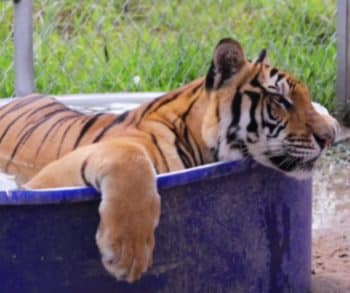
The first time Maruay eased himself into the cool, sparkling water at his sanctuary, it was impossible not to feel emotional watching him. His powerful striped body moved with surprising gentleness as he tested the pool, then fully surrendered to it, splashing and paddling with pure delight. He swatted at the ripples like an oversized cub discovering a new toy, then rolled slightly to float, completely at ease. In that simple, playful moment, you could see a tiger rediscovering something he had been denied for far too long: freedom, comfort, and unburdened joy.
 Credit: Facebook
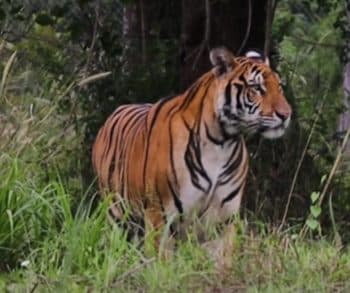
Today, Maruay is calm, playful, and full of life. He loves nothing more than drifting in the water or bounding through the grass. He rolls onto his back, stretches in the sunshine, and watches the world around him with quiet contentment. It is hard to imagine that his early years were spent somewhere so different.
Maruay was born at Phuket Zoo in Thailand. For the first two years of his life, he lived in cramped, crumbling enclosures. The space was small and barren. There was little room to roam, no soft grass beneath his paws, no pools to cool off in. Like many captive-bred tigers, he was raised to be a tourist photo prop. Visitors would come and go, but Maruay remained confined behind concrete and metal.
The environment took more than physical space from him. Tigers are curious and intelligent animals. They need stimulation, territory, and the freedom to explore. Instead, Maruay’s world was limited to a few steps in each direction. The noise and constant presence of people must have been overwhelming. Yet even then, he maintained a gentle and steady spirit.
A 700-Kilometer Journey to Freedom
 Credit: Facebook
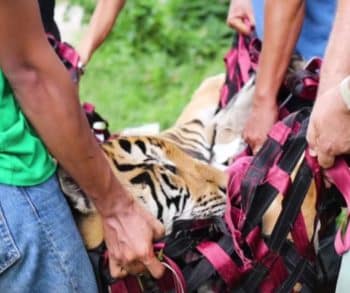
Tom from the Wildlife Friends Foundation Thailand spent months working to secure the release of the zoo’s tigers and bears. Negotiations were not simple. Rescue requires patience, persistence, and careful planning. Finally, the day came when Maruay’s future changed forever.
He was carefully placed into a transport crate and driven nearly 700 kilometers to the rescue center. The journey was long and unfamiliar. Every sound and movement must have felt uncertain. He had no way of knowing that each passing mile carried him closer to safety.
When the crate door finally opened, Maruay stepped into a completely new world. Grass stretched beneath his paws. Trees swayed gently nearby. Clean pools of water shimmered in the sunlight.
He did not hesitate.
Maruay bolted forward, sprinting through the grass. He explored every corner, then made a beeline for the water. With a powerful leap, he dove in. He splashed, paddled, and floated as if he had been waiting his whole life for that moment.

Over time, his playful energy settled into peaceful confidence. He learned that this place was different. Here, there were no crowds pressing in. No tiny cages. No expectations. Just space, safety, and care.
Now, Maruay spends his days exactly as a tiger should. He lounges in the shade when the heat rises. He swims whenever the mood strikes. He interacts calmly with his surroundings, secure in the knowledge that he is protected.
 Credit: Facebook
For Tom and the rescue team, seeing Maruay thrive is a powerful reminder of why their work matters. Each rescued animal carries a story of hardship. But they also carry resilience. Watching Maruay float lazily in his pool, eyes half closed in contentment, shows what is possible when compassion replaces captivity.
Maruay’s transformation is not just about physical freedom. It is about dignity. It is about giving a wild animal the chance to feel safe, curious, and joyful again.







 English (US) ·