
 3 weeks ago
29
3 weeks ago
29
For many dog parents, the search for a dog fence begins with a simple priority: keeping their dog safely contained without installing a tall physical barrier. Whether you are researching an invisible fence for dogs for the first time or comparing newer systems to a traditional dog fence, the number of options available today can quickly become overwhelming.
The term “invisible fence” is often used broadly, but it actually encompasses several types of technology. A classic invisible dog fence usually refers to an underground dog fence that relies on a buried wire dog fence layout installed around the perimeter of your property. This type of hidden dog fence connects to a transmitter and works with an invisible fence collar worn by the dog. As the dog approaches the boundary, the invisible dog fence collar emits a warning tone and, if necessary, a static correction to reinforce the limit.
In contrast, GPS wireless dog fence technology has expanded what a modern dog containment system can do, allowing owners to create custom-shaped boundaries without buried wires.

Because there are several types of dog fence systems available today, many dog parents start by trying to understand the basics. They want to know how an invisible fence, also referred to as an underground fence, works compared to newer dog fence options. As they dig deeper, comparisons like underground fence vs wireless dog fence become important, especially when weighing installation, boundary flexibility, and reliability.
Safety is another major factor in the decision-making process. It is common for owners to ask whether underground dog fences are safe and whether invisible fences hurt dogs, particularly when considering how an invisible fence collar delivers feedback. Beyond safety and setup, interest is also growing around invisible fence alternatives. Many pet parents are actively researching alternatives to invisible dog fence systems as GPS-based technology and wireless innovations reshape what a modern dog containment system can offer.
Ultimately, most dog parents are trying to answer one core question: what type of dog containment system is safest, most effective, and most flexible for their dog and property? Understanding the differences between a traditional underground dog fence and a GPS dog fence is essential before making a decision. In the sections ahead, we will break down how each invisible fence for dogs works, compare installation and training requirements, explore safety considerations, and explain why many pet owners are now considering modern alternatives like the Halo Collar as a more flexible evolution of the invisible dog fence concept.
For a limited time, readers can save $25 on the Halo Collar 5, lowering the price from $524 to $499 when purchased through our link. Click here and save!
What Is an Invisible Fence?
An invisible fence is a dog containment system that creates a boundary without a visible physical barrier. Instead of wood, vinyl, or metal panels, it relies on buried wires.
A traditional invisible dog fence is often an underground dog fence that uses a buried wire dog fence installed around the yard’s perimeter. The dog wears an invisible dog fence collar that detects the signal from that wire. When the dog approaches the boundary, the collar issues a warning tone and may deliver a correction if the dog continues forward.
Most invisible dog fence systems require a collar that delivers either a warning sound, vibration, or static stimulation to reinforce the boundary. The effectiveness of any hidden dog fence depends not just on the technology but also on proper training and fit.
Here’s how it works:
- A wire is buried around the perimeter of the property.
- The transmitter sends a signal through the buried wire dog fence loop.
- The dog wears an invisible fence collar.
- As the dog approaches the boundary, the collar emits a warning tone.
- If the dog continues past the boundary, the collar delivers a correction.
Because the signal travels through a closed loop, any break in the wire can disrupt the system until repaired. Many properties also have characteristics that make it difficult to install an in-ground wire fence, such as rocks, trees, driveways, water, and changes in elevation. Not to mention that rental properties will not allow you to install an in-ground wired fence.
Types of Dog Containment Systems Compared
When choosing a dog containment system, most owners are evaluating more than just whether it keeps their dog inside the yard. Installation complexity, flexibility, safety, maintenance, and long-term cost all play a role. Below is a breakdown of the primary options available today, including invisible fence alternatives.
Physical Fence
Best For: Homeowners who want a visible, permanent barrier
Installation: Requires materials, labor, and often permits
Custom Boundary Shape: Fully customizable
Portability: Not portable
Correction Type: Physical barrier
Ongoing Costs: Maintenance and repairs
Flexibility: Fixed once installed
A traditional physical fence remains the most visible and straightforward containment method. It creates a solid boundary that prevents dogs from leaving the yard and can also deter outside animals from entering.
However, physical fences are often the most expensive upfront option and may not be allowed in some neighborhoods due to HOA restrictions. They also lack flexibility. Once built, the boundary cannot easily be adjusted. For renters or frequent movers, a permanent structure is rarely practical.
Invisible Dog Fence (Underground Dog Fence)
Best For: Homeowners seeking a hidden perimeter with a fixed layout
Installation: Requires burying a wire around the property
Custom Boundary Shape: Customizable
Portability: Not easily portable
Correction Type: Tone and static via invisible fence collar
Ongoing Costs: Wire repairs and servicing
Flexibility: Limited once installed
A wire is buried around the perimeter of the yard and connected to a transmitter. The dog wears an invisible dog fence collar that receives a signal when approaching the boundary.
Installation requires digging and can be labor-intensive. If the buried wire breaks due to landscaping, weather, or yard work, the entire system may stop functioning until repaired.
Because of the installation demands and lack of portability, many owners begin exploring invisible fence alternatives after researching traditional underground setups.
GPS Wireless Dog Fence (Halo Collar Category)
Best For: Owners seeking flexibility, portability, and customization
Installation: No digging or base station required
Custom Boundary Shape: Fully customizable via GPS mapping
Portability: Highly portable
Correction Type: Tone, vibration, and adjustable feedback via smart collar
Ongoing Costs: Subscription-based platform
Flexibility: Dynamic and adjustable containment
A GPS wireless dog fence represents the most modern evolution in dog fences. Instead of relying on buried wires or a central radio transmitter, this type of dog containment system uses GPS technology to create virtual boundaries that can be customized through a mobile app.
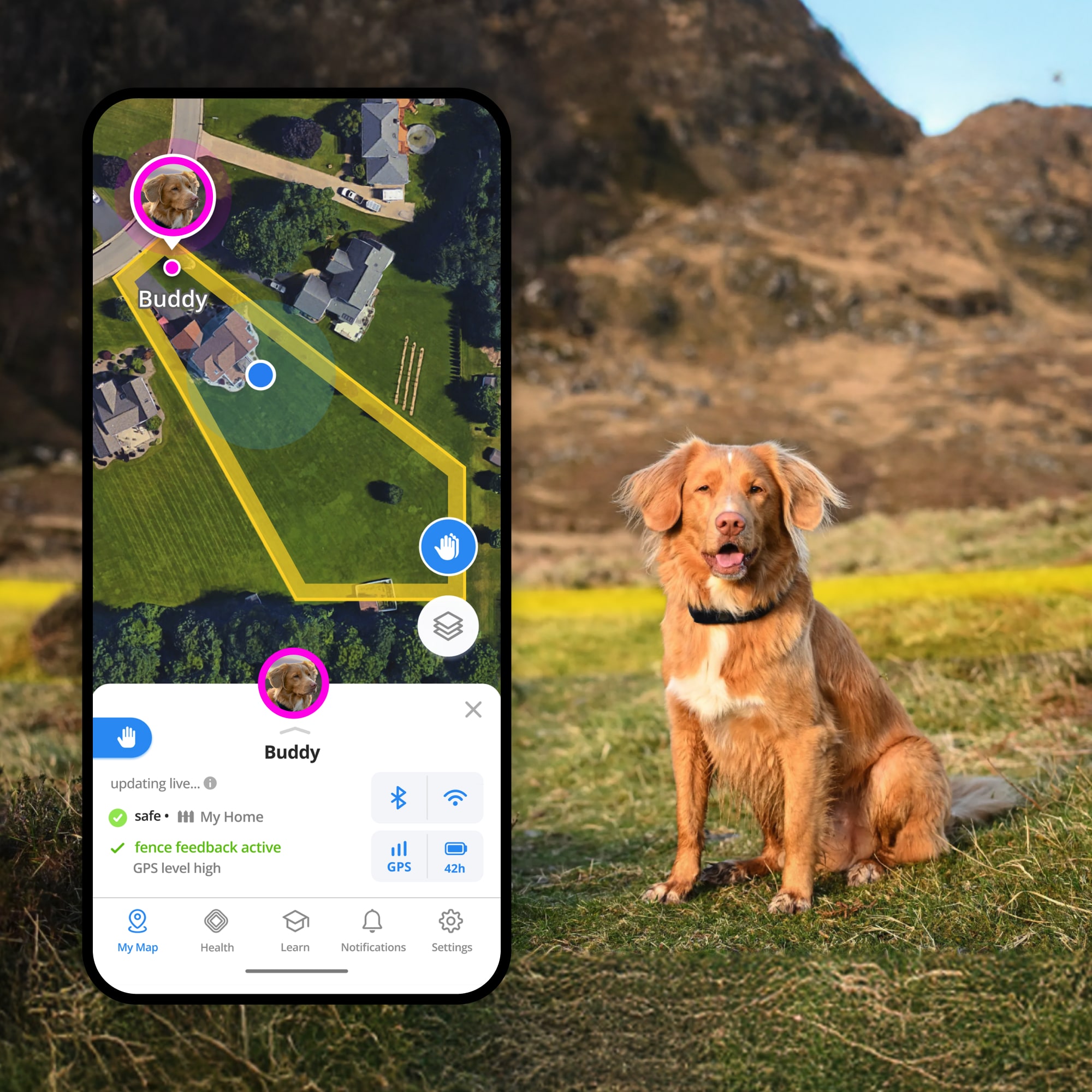
Within this category, the Halo Collar is one of the most recognized examples of a GPS wireless dog fence system, combining customizable virtual boundaries with built-in tracking and integrated training tools in a single smart dog collar containment system. Unlike traditional systems that rely on a circular signal radius or buried perimeter wiring, Halo Collar allows owners to design unlimited custom fence shapes that follow actual property lines. Not only can you create fences in seconds, but it can also be used effectively in any yard or area, even those that present challenging geographical features. Because there is no buried wire dog fence to install, there is no digging, no risk of wire breaks, and no permanent hardware embedded in the yard. This allows boundaries to be adjusted digitally as property layouts or lifestyle needs change.
The Halo Collar also offers Cesar Millan’s patented in-app training, which is based on positive associations. If your dog crosses a boundary, your Halo Collar will guide them back to safety and never give correction feedback to a dog that is re-entering their safe zone.
The Halo Collar app also offers real-time alerts so you can know exactly where your dog is at all times, and Halo Health to monitor your dog’s activity, walks, and much more.
For dog owners researching invisible dog fences that provide greater flexibility, GPS wireless dog fence systems offer a modern solution. They are especially appealing for renters, rural property owners, travelers, and anyone who wants the ability to adjust boundaries without reinstalling equipment.
Are Underground Dog Fences Safe?
Are underground dog fences safe? In many cases, yes, when properly installed and paired with appropriate training. However, safety depends on several factors.
Most underground dog fence systems use adjustable correction levels delivered through an invisible fence collar. The goal is to interrupt behavior, not cause harm. Still, concerns about whether invisible fences hurt dogs are common.
Potential issues include:
- Dogs becoming frustrated by the boundary.
- Some dogs running through the correction if highly motivated.
- Dogs may be scared to re-enter the fence because they might be shocked again.
- If your dog does cross the invisible fence line, its whereabouts thereafter cannot be tracked.
- No physical barrier to prevent outside animals from entering the yard.
Training plays a major role in safety. A properly fitted invisible dog fence collar, gradual boundary introduction, and supervision all contribute to positive outcomes.
Do Invisible Fences Hurt Dogs?
Do invisible fences hurt dogs? Modern systems are designed to get a dog’s attention, not to cause injury. The static stimulation used in most invisible fence for dogs systems is similar to that used in many training collars.
That said, each dog responds differently. Proper collar fit, gradual training, and consistent reinforcement are essential. For particularly sensitive dogs, some owners explore alternatives to an invisible fence for dogs, such as sound or vibration-based systems that rely on static correction.
How to Train a Dog on an Invisible Fence
Understanding how to train a dog on an invisible fence is just as important as choosing the right system.
A typical training process includes:
- Introduce boundary flags so your dog can visually associate the edge.
- Begin with a tone-only phase to teach awareness of the boundary.
- Gradually introduce correction if the dog ignores the warning tone.
- Reinforce recall commands within the containment zone.
- Supervise early off-leash sessions carefully.
With any dog containment system, consistency is key.
Common Downsides of Traditional Invisible Fences
While a buried wire dog fence can be effective, traditional invisible fence systems have limitations.
Common drawbacks include:
- Digging and labor-intensive installation.
- Risk of wire breaks requiring repair.
- Fixed boundary shape once installed.
- No GPS dog tracker.
- No protection against outside animals.
- Limited portability.
- Difficulty adjusting property lines.
Because of these limitations, many dog parents are now seeking invisible dog fence alternatives that offer greater flexibility.
What Are the Best Invisible Dog Fence Alternatives?
Invisible dog fence alternatives often fall into three categories:
- GPS dog trackers.
- Smart dog collar containment systems.
- Hybrid models that combine tracking and boundary features.
Among these, a GPS wireless dog fence system represents the most advanced evolution. They remove the need for a buried wire dog fence and allow owners to adjust boundaries digitally.

Why GPS Wireless Dog Fence Systems Are Gaining Popularity
A GPS wireless dog fence combines containment with modern technology.
Advantages include:
- No buried wire installation.
- Custom-shaped boundaries created through an app.
- Portability across properties.
- Real-time location tracking.
- Activity monitoring.
- Remote training adjustments.
For dog parents seeking more than a traditional wireless dog fence, this category offers both containment and connectivity.
 How Halo Collar Modernizes Dog Containment
The Halo Collar functions as a GPS wireless dog fence and a 4-in-1 comprehensive dog containment system. Instead of relying on buried wire infrastructure, it uses GPS technology to create customizable virtual fences.
As a modern alternative to underground dog fence systems, Halo Collar allows pet parents to:
- Create fences without digging in seconds
- Adjust boundaries at any time
- Use portable containment across multiple locations
- Monitor your dog’s location with real-time tracking and as well as their health
- Customize feedback levels
Designed with input from Cesar Millan, the Halo Collar integrates containment, GPS dog tracking, health monitoring, and training tools into a single smart collar solution.
As the leader in the wireless dog fence category, Halo Collar offers:
- Up to 48-hour battery life
- 20 location updates per second for unmatched precision
- AlwaysOn™ GPS with nonstop, real-time tracking (no low-power modes) with Dual-frequency GPS (L1 & L5 bands)
- Wi-Fi, Bluetooth, and LTE/cellular connection with all-carrier worldwide coverage
- Separated Wi-Fi & Bluetooth chips for faster, more stable connections
- Rapid charging — fully powered in just 1 hour
- Halo Health app with detailed activity & wellness insights
- IP67 waterproofing and a dog-proof build
- One-on-one live Zoom customer support available seven days a week

Who Should Consider an Invisible Fence vs a GPS Wireless Dog Fence Alternative?
A traditional invisible fence may work well for:
- Permanent homeowners.
- Large, fixed yards.
- Budget-focused buyers.
A GPS wireless dog fence, like a Halo Collar, may be better for:
- Renters.
- Travelers.
- Rural property owners.
- Irregular-shaped lots.
- Owners seeking flexibility.
When evaluating an underground fence vs wireless fence options, considering lifestyle is just as important as technology.
Cost Comparison: Invisible Fence vs GPS Wireless Dog Fence
Cost often becomes the deciding factor.
Equipment:
An underground dog fence requires a transmitter, buried wire, and an invisible fence collar. A GPS wireless dog fence integrates technology into the collar itself.
Installation:
Traditional invisible fence systems may require professional installation and trenching. GPS systems require no digging.
Maintenance:
Buried wire dog fence systems can require repairs if damaged. GPS wireless dog fences avoid wire repair but may include subscription costs.
Long-Term Value:
An underground dog fence creates a fixed boundary. A GPS wireless dog fence offers adjustable boundaries and portability.
When comparing invisible fence alternatives, long-term flexibility can weigh as heavily as initial price.
Frequently Asked Questions
1. Are underground dog fences safe for all breeds?
Underground dog fences can be safe for many breeds when properly installed and paired with consistent training. Most invisible fence systems include adjustable correction levels, allowing owners to match the feedback to their dog’s size and temperament.
However, effectiveness depends on the individual dog. Highly driven, anxious, or distraction-prone dogs may respond differently. Proper collar fit, gradual boundary training, and supervision are essential to ensure that an invisible dog fence collar is used safely and effectively.
3. Do invisible fences hurt dogs long term?
Modern invisible dog fence systems are designed to interrupt behavior rather than cause injury. The static stimulation used in most invisible fence collars is similar to that used in many professional training tools.
When used correctly and paired with proper training, long-term harm is unlikely. Issues typically arise from improper collar fit, skipping the training phase, or inconsistent reinforcement. Responsible use plays a major role in positive outcomes.
4. How does a wireless dog fence work without wires?
A GPS wireless dog fence works without a buried wire dog fence by using satellite positioning instead of a physical signal loop. Rather than relying on underground wiring, the system creates virtual boundaries through GPS mapping.
The dog wears a smart collar that communicates with satellites and a mobile app. When the dog approaches the digital boundary, the collar delivers feedback such as tone, vibration, or optional static feedback.
5. What are the best alternatives to invisible dog fence systems?
The most common invisible dog fence alternatives include GPS-based containment systems and smart collars that combine virtual boundaries with real-time tracking.
Unlike a traditional underground dog fence or basic wireless dog fence, a GPS wireless dog fence offers portable containment and customizable boundary shapes. For dog parents seeking more flexibility, travel, or those who relocate frequently, these alternatives to an invisible fence for dogs provide a modern solution without buried wires.
Choosing the Right Dog Fence
Every dog containment system has tradeoffs. Traditional invisible fence systems are established but require digging and ongoing maintenance. GPS wireless dog fence systems, like the Halo Collar, offer portability, adjustable boundaries, and modern safety and tracking tools designed to adapt to changing needs.
For dog parents who anticipate moving, redesigning their yard, traveling, or simply wanting the ability to adjust boundaries without reinstalling hardware, GPS wireless dog fence systems provide a level of flexibility traditional systems cannot match.
If you’re researching the best dog fence, understanding the differences between invisible fence systems and wireless dog fence alternatives can help you choose a solution that fits your dog, property, and lifestyle…not just today, but long term.











 English (US) ·