
 1 month ago
43
1 month ago
43
If you love everything about Poodles but you’re curious whether another breed might fit your life better, you’re not alone. Maybe you want a bigger dog, a more laid-back temperament, or just something a little different from the usual. The good news: there are 10 breeds that share what makes Poodles great, including low-shedding coats, sharp minds, and friendly personalities.
This guide covers all 10 of them, with honest breakdowns of how they compare to Poodles. You’ll also find a traits comparison card and a full FAQ at the bottom. If you’re still narrowing down the list, check out our full roundup of 18 low-shedding dog breeds for even more options.
📋 Quick Comparison: 10 Dog Breeds Similar to Poodles
| Bichon Frise | Small | Curly, dense | Very low | High |
| Portuguese Water Dog | Medium | Curly or wavy | Low | Very high |
| Spanish Water Dog | Medium | Curly, woolly | Low | High |
| Barbet | Medium | Long, curly | Low | High |
| Irish Water Spaniel | Medium-Large | Tightly curled | Low | High |
| Soft-Coated Wheaten Terrier | Medium | Silky, wavy | Low-moderate | Moderate |
| Kerry Blue Terrier | Medium | Soft, curly | Very low | Moderate-high |
| Bedlington Terrier | Small-Medium | Curly, woolly | Very low | Moderate |
| Schnauzer | Mini/Std/Giant | Wiry, dense | Low | High |
| Lagotto Romagnolo | Medium | Thick, curly | Low | Very high |
1. Bichon Frise
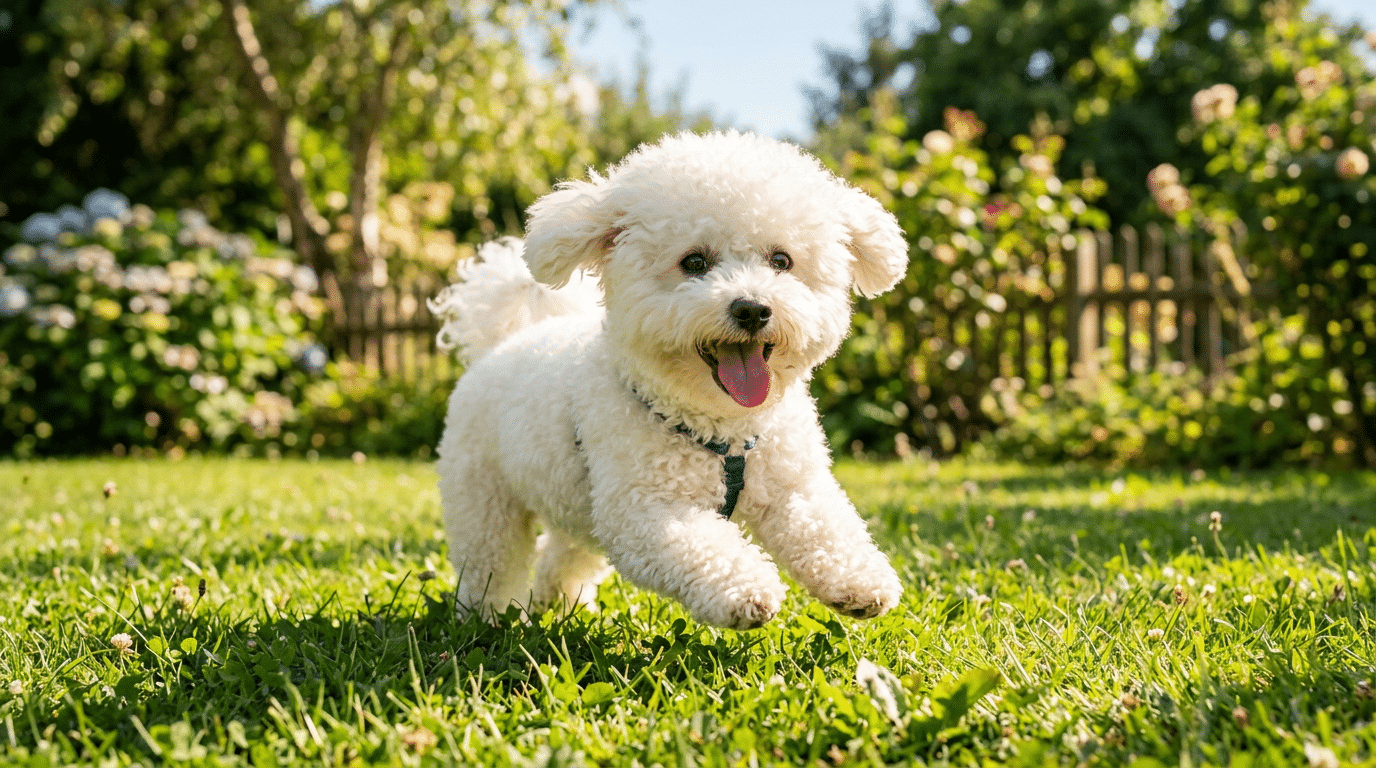
The Bichon Frise is probably the closest match to a Miniature Poodle in terms of day-to-day living. Both are small, low-shedding, and absolutely people-focused. If you’ve spent time with a Poodle and loved how interactive they are, you’ll feel right at home with a Bichon.
The coat is dense and curly, but it’s cotton-soft rather than the tighter curl you’d find on a Poodle. Bichons don’t shed much, which makes them a solid choice if allergies are a concern for your household. That said, their coat does need regular brushing and professional grooming every 6-8 weeks, so the maintenance commitment is real.
Personality-wise, Bichons are joyful, clownish, and endlessly affectionate. They love learning tricks, they do well in apartments, and they get along well with kids and other pets. The main difference from a Poodle? Bichons can be a bit more stubborn during training. They’re smart, but they’d rather charm their way out of a task than work at it. Keep sessions short and reward-heavy. Check out the ultimate Bichon Frise feeding guide if you bring one home.
Best for: Families, apartment dwellers, allergy-sensitive households.
2. Portuguese Water Dog
This is the breed for people who want a Poodle-level brain in a slightly more athletic package. Portuguese Water Dogs were bred to work alongside fishermen in Portugal, retrieving gear, herding fish into nets, and swimming through rough water. That working heritage shows up in everything they do.
Their coat is either tightly curled or wavy, and like a Poodle’s, it doesn’t shed much. They come in black, brown, and white combinations, and they typically weigh between 35-60 pounds, making them a good step up in size from a Miniature Poodle without being overwhelming.
What really stands out with Portuguese Water Dogs is their eagerness to work with you. They’re not just smart; they want a job. Daily exercise is non-negotiable. A Portuguese Water Dog stuck in a backyard with nothing to do will invent its own entertainment, and you probably won’t like what it comes up with. If you’re active, this breed will match your energy every single day.
Best for: Active owners, families with outdoor lifestyles, experienced dog owners.
3. Spanish Water Dog
Less well-known than its Portuguese cousin, the Spanish Water Dog is a medium-sized herding and working dog that shares a lot of Poodle DNA in terms of coat and intelligence. Their coats form natural, tight cords over time if left unclipped, similar to a Poodle’s cords, and they shed very little.
Spanish Water Dogs are intense workers. They’re protective of their family and generally reserved with strangers, so early socialization is important. They do best with consistent, experienced handling rather than first-time owners. Once bonded, they’re incredibly loyal and athletic.
If you’re drawn to Poodles because of their working dog roots, the Spanish Water Dog gives you that in full. They excel at herding trials, agility, and search-and-rescue work. Expect to spend 60-90 minutes a day on exercise and mental stimulation.
Best for: Experienced handlers, active households, working dog enthusiasts.
4. Barbet
The Barbet (pronounced “bar-bay”) is a French water dog that actually predates the Poodle and may be one of its ancestors. These are medium-sized, curly-coated, gentle dogs that are still relatively rare in the US, which means if you’re looking for something a little different, a Barbet fits the bill.
Their coat is long, curly, and water-resistant, much like a Poodle’s but often slightly looser in curl. They’re low-shedding and considered suitable for some allergy sufferers, though no dog is truly 100% hypoallergenic. Regular grooming every 6-8 weeks keeps the coat manageable.
Temperament-wise, Barbets are easygoing, sociable, and affectionate without being clingy. They adapt well to family life, get along with other animals, and love outdoor adventures. If you enjoy hiking, swimming, or any water activities, a Barbet will be your ideal companion. They’re trainable and respond well to positive reinforcement.
Best for: Active families, people who want a rare breed, outdoor enthusiasts.
5. Irish Water Spaniel
The Irish Water Spaniel is the largest of the spaniel group and one of the most distinctive-looking dogs on this list. They have tightly curled, liver-colored coats that cover most of their body, with a smooth “rat tail” that’s completely unique. They look a bit like a Poodle crossed with a Labrador, and honestly, that’s not far off functionally.
These dogs were bred for hunting waterfowl in cold, rough water, and their double coat is designed to repel water. Shedding is minimal, and the coat doesn’t require daily brushing, though it does need trimming every few months to stay neat.
Irish Water Spaniels are energetic, playful, and a bit goofy. They can be cautious around strangers and may not be the best fit for homes with very young children. But for active families with older kids, they’re wonderful. They need a lot of exercise, and they thrive when they have something physical to work toward.
Best for: Active families, hunters, owners who want a large, low-shedding dog.
6. Soft-Coated Wheaten Terrier
Wheaten Terriers break the mold a bit on this list. Their coat isn’t curly; it’s silky and wavy, with a distinctive soft texture that sets them apart from most terrier breeds. They shed less than many dogs, though not as minimally as a Poodle. They’re also a bit more energetic and stubborn than the average Poodle.
These dogs are cheerful, playful, and highly social. They do well in families and tend to be friendlier with strangers than most terriers. The “Wheaten greeting” is a real thing: expect jumping, spinning, and general chaos when you arrive home.
Training takes patience. Wheatens are smart enough to know exactly what you want, and they’ll decide whether or not to do it based on mood. Consistent, positive training methods work best. They need daily exercise and mental stimulation, but they’re adaptable enough for suburban life as long as they get out regularly.
Best for: Families, active owners who want a friendly terrier energy without excessive shedding.
7. Kerry Blue Terrier
The Kerry Blue Terrier has one of the most distinctive coats on this list. Born black, their coats shift to a blue-gray over the first 18 months of life. The texture is soft and wavy, similar to a Poodle’s in feel, and they shed very little. Regular grooming keeps the coat from matting.
Personality-wise, Kerry Blues are spirited, confident, and deeply attached to their families. They have a strong prey drive, which means they may not be safe around cats or small animals without early socialization. They can also be dog-selective, especially with dogs of the same sex. They’re not a pushover breed.
That said, they’re incredibly loyal and fun-loving once they trust you. They excel in obedience, agility, and herding trials. If you’ve always loved the Poodle’s versatility as a performance dog and want something with a bit more edge, a Kerry Blue is worth considering. They’re also a much less common breed, so you’ll stand out at the dog park. For more versatile breed profiles, browse our list of breeds similar to Schnauzers, which share some of the same bold personality traits.
Best for: Experienced owners, dog sport enthusiasts, people who want a bold but low-shedding terrier.
8. Bedlington Terrier
At first glance, a Bedlington Terrier looks like a lamb. Their pale, curly coat and arched back give them an almost surreal appearance that surprises people who haven’t seen one before. But don’t let the gentle look fool you. These dogs were bred to hunt badgers and rats, and they have the tenacity to back it up.
The coat is a mix of hard and soft hair that forms a distinctive curl, and it sheds minimally. Grooming is needed every 6-8 weeks to keep the signature shape. Colors include blue, liver, and sandy, often with tan markings.
Bedlingtons are affectionate, playful, and surprisingly graceful. They love to run and are faster than they look. They’re moderately easy to train, though they can be independent-minded at times. For families that want a low-shedding dog with a unique appearance and a spunky personality, Bedlingtons are genuinely underrated. You can also compare them against the Maltese-type breeds if you’re looking at smaller, low-shedding options.
Best for: Families, active owners, people who want a rare, eye-catching breed.
9. Schnauzer
Schnauzers come in three sizes: Miniature (12-20 lbs), Standard (30-50 lbs), and Giant (55-85 lbs), just like Poodles. That alone makes them one of the most practical alternatives if size is a key factor in your decision. All three sizes share the same core traits: smart, alert, loyal, and spirited.
Their wiry double coat doesn’t shed much and is considered low-dander, making them a reasonable option for mild allergy sufferers. The coat needs hand-stripping or clipping every few months, plus regular brushing to prevent matting around the beard and legs.
Schnauzers are natural watchdogs. They’re vocal, observant, and protective without being aggressive. Miniature Schnauzers tend to be a bit more energetic and social than Standards or Giants, but all three are highly trainable and enjoy having a job to do. They do well in dog sports and make excellent family companions. See our full breakdown of breeds similar to Schnauzers for more context on how they compare across personality types.
Best for: Families of all sizes, people who want size flexibility, anyone who likes a confident, alert dog.
10. Lagotto Romagnolo
The Lagotto Romagnolo (lah-GOT-oh ro-man-YOH-lo) might be the most underrated dog on this list. Originally bred for waterfowl hunting in the Italian marshlands and later trained as truffle hunters, Lagottos are compact, curly-coated, and brilliantly intelligent. Their nose is something special. They’re among the best scent workers of any breed.
Their thick, curly coat is waterproof and sheds minimally. It needs regular attention to prevent matting, but it doesn’t require the elaborate grooming styles associated with Poodles. Colors include roan, brown, orange, and white. Most Lagottos weigh 24-35 pounds, putting them solidly in the medium-small range.
Temperament-wise, Lagottos are affectionate, eager to please, and calm enough for family life without being low-energy. They love puzzle toys and nose work activities. If you feed your dog raw food, check out the best raw dog food brands for Poodles, which works equally well for Lagottos and similar breeds. They’ve also started appearing in AKC rankings more frequently. The AKC’s most popular breed rankings show them climbing steadily as more owners discover them.
Best for: Active owners who love nose work, families, people who want a rare Italian breed with Poodle-like qualities.
✂️ Grooming & Training Needs at a Glance
| Bichon Frise | Every 6-8 weeks | Low-moderate | Easy (with patience) |
| Portuguese Water Dog | Every 6-8 weeks | High | Easy |
| Spanish Water Dog | Every 8-10 weeks | High | Moderate |
| Barbet | Every 6-8 weeks | Moderate-high | Easy |
| Irish Water Spaniel | Every 8-10 weeks | High | Moderate |
| Soft-Coated Wheaten | Every 6-8 weeks | Moderate-high | Moderate |
| Kerry Blue Terrier | Every 6 weeks | Moderate-high | Moderate |
| Bedlington Terrier | Every 6-8 weeks | Moderate | Moderate |
| Schnauzer | Every 6-8 weeks | Moderate-high | Easy |
| Lagotto Romagnolo | Every 8 weeks | Moderate | Easy |
What Makes Poodles Different From Other Breeds?
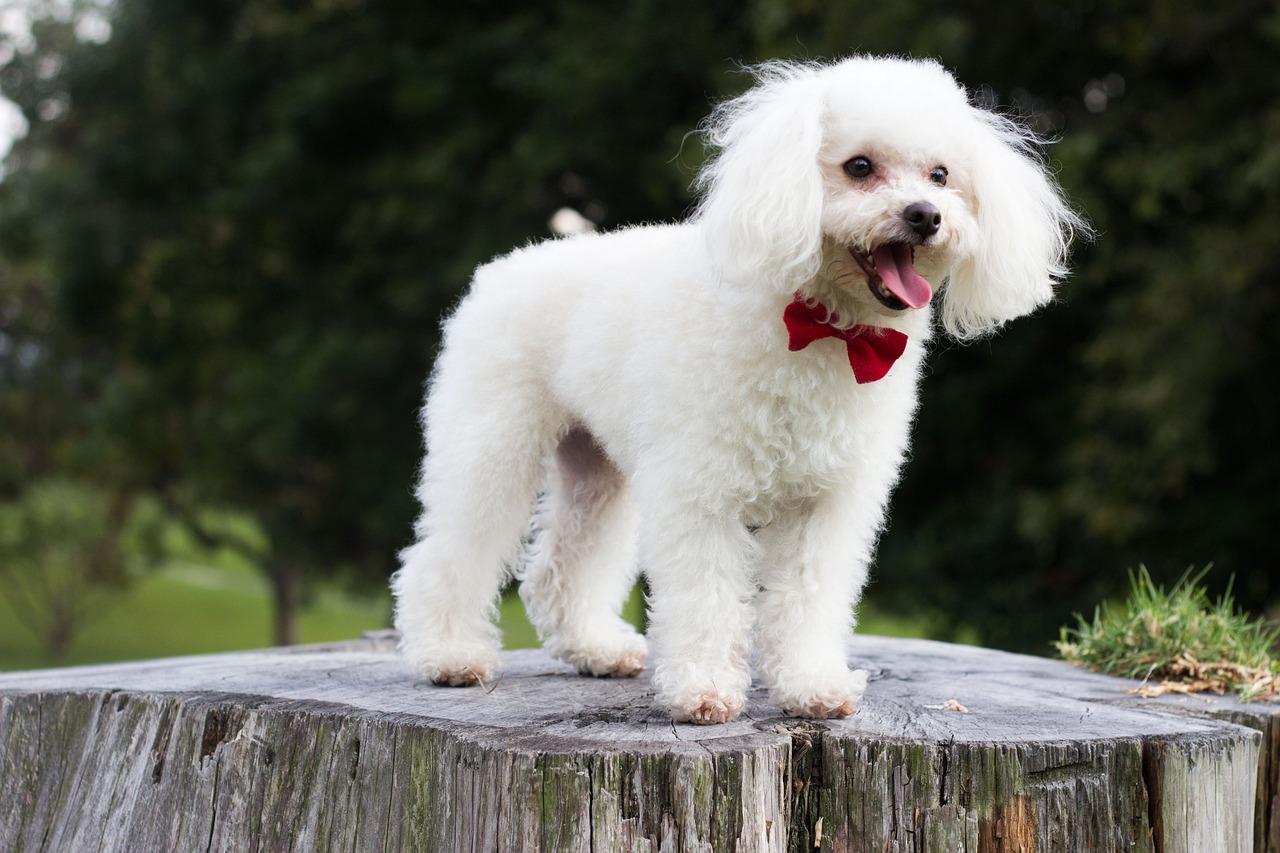
Poodles consistently rank among the most popular dog breeds in the US, and it’s not just about looks. They’re second only to Border Collies in measured intelligence, which means they pick up new commands fast, generalize what they learn, and stay mentally sharp well into old age.
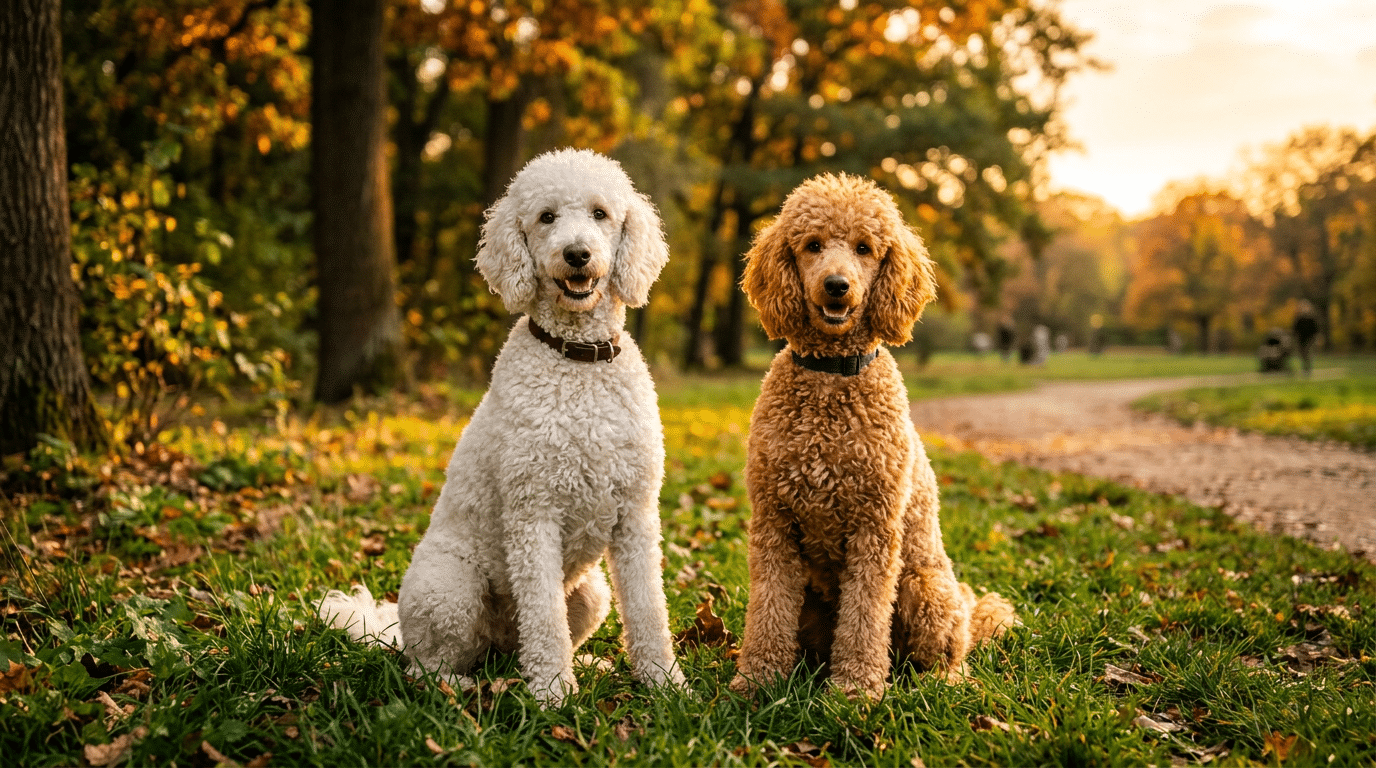
Their coats are dense and curly, growing continuously rather than shedding in cycles like most double-coated breeds. This is why Poodles are often recommended for people with mild allergies. The trade-off is a grooming commitment every 6-8 weeks without fail, or you’ll end up with a matted mess.
Poodles come in three sizes: Standard (over 15 inches at the shoulder), Miniature (10-15 inches), and Toy (under 10 inches). All three have the same basic temperament: sociable, alert, eager to please, and surprisingly athletic. Standard Poodles were originally water retrievers. Miniature Poodles were truffle hunters. Toy Poodles were companion dogs for French aristocrats. That multi-role history is why they’re so adaptable today.
One thing that surprises new Poodle owners is how athletic they are. Despite the fancy haircuts, they’re not fragile or delicate dogs. They love to run, swim, and work. If you’re comparing notes on other small, low-shedding breeds like Maltese or looking at breeds similar to Golden Retrievers for a larger option, keep in mind that Poodles sit in a unique spot: they’re both elegant and genuinely sporty.
Health-wise, Standard Poodles can be prone to hip dysplasia and certain eye conditions. Miniature and Toy Poodles sometimes deal with dental crowding due to their smaller jaws. Regular vet checkups, good nutrition, and keeping their weight in check go a long way. If you’re planning ahead on feeding, the best puppy foods for Poodles can give you a solid starting point regardless of which curly-coated breed you end up choosing.
Frequently Asked Questions: Dog Breeds Similar to Poodles
What dog is most similar to a Poodle?
The Bichon Frise is the closest match in terms of temperament and coat type for small-dog households. For medium-to-large dogs, the Portuguese Water Dog is the top pick, sharing the same water-dog heritage, curly low-shedding coat, and high trainability as a Standard Poodle.
Are there hypoallergenic dogs similar to Poodles?
Several breeds on this list shed minimally and produce less dander than average, including the Bichon Frise, Portuguese Water Dog, Lagotto Romagnolo, Kerry Blue Terrier, and Bedlington Terrier. No dog is 100% hypoallergenic, but these breeds are generally better tolerated by people with mild allergies.
What breed looks like a Poodle but isn’t one?
The Bedlington Terrier and Barbet are often mistaken for Poodle mixes due to their curly coats and similar builds. The Lagotto Romagnolo also draws frequent comparisons, especially in its brown or roan coloring.
What’s the smartest breed similar to a Poodle?
The Portuguese Water Dog and Lagotto Romagnolo rank highest in working intelligence among Poodle-similar breeds. Both learn commands quickly, generalize well, and excel in structured training. Schnauzers are a close third, particularly for problem-solving and obedience tasks.
Do any of these breeds come in multiple sizes like Poodles?
Yes. The Schnauzer comes in Miniature, Standard, and Giant sizes, making it the closest parallel to the Poodle’s three-size lineup. All three Schnauzer sizes share the same core traits, just scaled differently.
How do these breeds compare for grooming effort?
Most Poodle-similar breeds need professional grooming every 6-8 weeks. The Irish Water Spaniel and Spanish Water Dog can stretch to 8-10 weeks between appointments. None of these breeds are wash-and-wear dogs, so factor in grooming costs of $60-$120 per appointment when budgeting.
Which Breed Is Right for You?
So which of these 10 dog breeds similar to Poodles actually fits your life? Here’s the short version:
If you want the smallest possible dog with the least shedding, the Bichon Frise is your best bet. If you’re active and want a high-energy working partner, go with the Portuguese Water Dog. If you want Poodle-level intelligence in a size-flexible package with watchdog instincts, the Schnauzer is hard to beat. And if you want something genuinely rare that most people won’t recognize at the dog park, look at the Barbet or the Lagotto Romagnolo.
Every breed on this list shares something with the Poodle: low shedding, above-average intelligence, or that particular quality of wanting to be near their people. Pick the one that matches your activity level and living situation, and you’ll be in good shape. Want to keep comparing? Check out our guides on dog breeds similar to Border Collies and dog breeds that start with P for more breed discovery.




 English (US) ·